AC fans
AC axial cooling fans
Built on time-tested shaded-pole and capacitor-run motor designs, JyFan AC fans deliver reliable, cost-effective cooling. With model options for 100–380 V AC mains, they operate without an external driver or controller, reducing purchasing costs and potential points of failure. All motors use high-quality enamelled copper windings, paired with die-cast aluminium housings for durable operation in high-temperature and salt-spray environments.
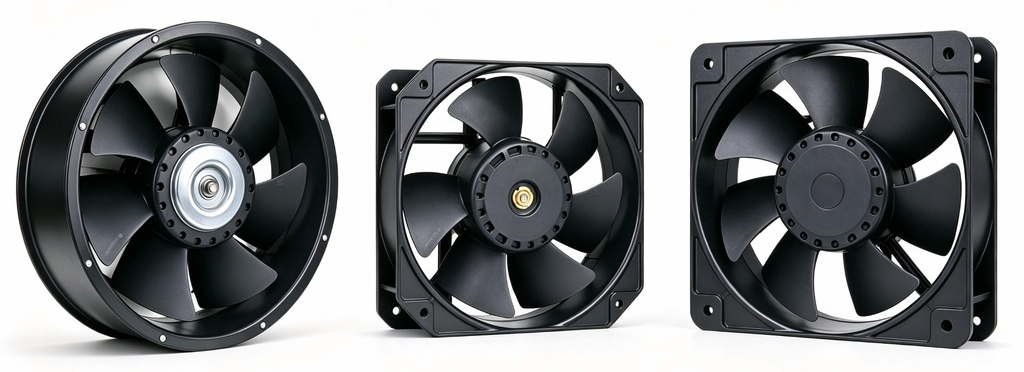
AC Fans Specifications
Frequency-specific data: JA18060HB1 is listed at 60 Hz and JA18060HB2 at 50 Hz. JA25489HB3 (380 VAC) is listed at 50 Hz only. See each linked model table for voltage-specific conditions.
Need a different size or configuration? Send your voltage, airflow, pressure and mounting requirements. Our team will review suitable options.
JA6030 AC fan
60 × 60 × 30mm
Specifications & drawings →80mm / 3.15 inchJA80 AC fan
80 × 80 × 25 / 38mm
Specifications & drawings →92mm / 3.6 inchJA92 AC fan
92 × 92 × 25 / 38mm
Specifications & drawings →110mm / 4.3 inchJA11025 AC fan
110 × 110 × 25mm
Specifications & drawings →120mm / 5.0 inchJA12025 AC fan
120 × 120 × 25mm
Specifications & drawings →JA12038 AC fan
120 × 120 × 38mm
Specifications & drawings →150mm / 5.9 inchJA15050 AC fan
150 × 150 × 50mm
Specifications & drawings →172mm / 6.8 inchJA17238 AC fan
172 × 150 × 38mm
Specifications & drawings →172mm / 6.8 inchJA17251 AC fan
172 × 150 × 51mm
Specifications & drawings →172mm / 6.8 inchJA17255 AC fan
172 × 150 × 55mm
Specifications & drawings →180mm / 7.0 inchJA18060 AC fan
180 × 180 × 60mm
Specifications & drawings →200mm / 7.9 inchJA20060 AC fan
200 × 200 × 60mm
Specifications & drawings →205mm / 8.0 inchJA20572 AC fan
205 × 205 × 72mm
Specifications & drawings →220mm / 8.7 inchJA22060 AC fan
Φ220 × 60mm
Specifications & drawings →225mm / 8.9 inchJA22580 AC fan
225 × 225 × 80mm
Specifications & drawings →254mm / 10.0 inchJA25489 AC fan
Φ254 × 89mm
Specifications & drawings →280mm / 11 inchJA28080 AC fan
280 × 280 × 80mm
Specifications & drawings →AC FAN MOTOR DESIGNS
Capacitor-Run & Shaded-Pole Motors
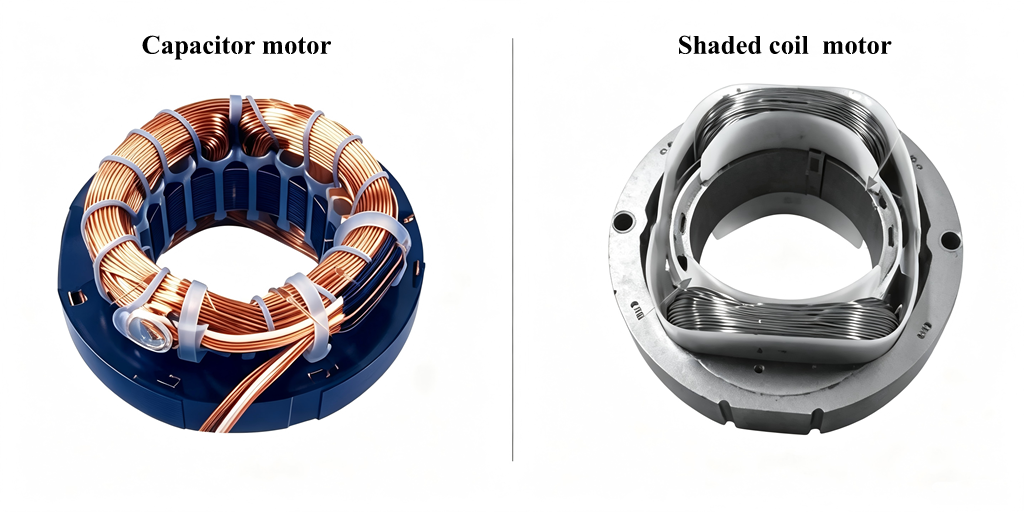
Capacitor-run motors use a capacitor with an auxiliary winding to create the phase shift needed for operation.
Shaded-pole motors use shading coils to create a rotating magnetic-field effect, providing a simple motor design for suitable AC fan applications.
Motor design varies by model. Confirm voltage, frequency, airflow, power consumption and any capacitor requirements in the selected fan’s documentation.
FAQ
AC Axial Fan FAQ
What is the difference between an AC axial fan and a DC fan?
An AC axial fan connects to its specified AC supply. A brushless DC fan needs a compatible DC supply and may offer PWM control and speed feedback. Choose based on the available power and control requirements.
How much airflow does an AC fan need to cool an electrical cabinet?
Start with the cabinet’s heat load and allowable temperature rise. Then account for filters, grilles and internal restrictions. Select a fan that delivers the required airflow at the installed pressure, and verify cabinet temperatures.
Shaded-pole or capacitor-run motor: which should I choose?
Shaded-pole motors suit compact, cost-sensitive fixed-speed applications. Capacitor-run motors generally offer higher efficiency and starting torque. Compare the actual models against your airflow, pressure, power and mounting requirements.
Does the same AC fan perform the same at 50 Hz and 60 Hz?
Not necessarily. Supply frequency can change speed, airflow, noise and power consumption. Use the performance data for the specified voltage and frequency, and confirm that the selected model supports your supply.
Are waterproof or dustproof AC axial fans available?
Protection options depend on the model and application. Share the expected dust, moisture and water exposure so JyFan can confirm a suitable configuration and its documented IP rating.
How long do JyFan AC axial fans last?
Service life depends on the bearing, ambient temperature, mounting orientation and operating conditions. Refer to the selected model’s life rating and test conditions rather than applying one service-life figure to the entire range.
Start with your cooling requirements.
Share the size, voltage, airflow, operating conditions and quantity.