APPLICATION ENGINEERING & PROCUREMENT
Axial Fan Supplier Guide: How to Choose the Right Manufacturer for Your Application
A practical guide for engineers and buyers sourcing AC, DC and EC cooling fans—from the first specification to production approval.
November 2, 2026 · JyFan Engineering Resources
1. Define the cooling duty before comparing suppliers
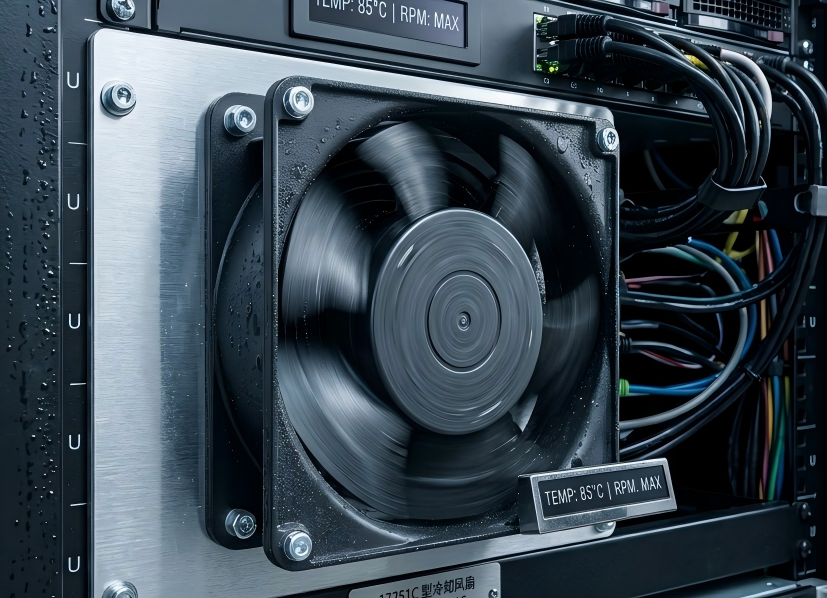
Prepare a short application brief: heat dissipation, ambient temperature, allowable component temperatures, available space and the route air will take through the enclosure. Include inlet and outlet restrictions, filters and nearby components. A shared brief makes supplier proposals easier to compare.
A catalog airflow figure alone cannot establish suitability. Ask for the pressure–airflow curve and identify the expected operating point with the enclosure resistance included. Maximum airflow and maximum static pressure occur at different points on the curve. Use the cooling fan selection guide and P–Q curve guide to prepare this discussion.
2. Choose the electrical architecture
- AC axial fans: Start here when the equipment provides a suitable AC supply. Confirm voltage, frequency and the model’s corresponding performance table. Browse JyFan AC fans.
- DC axial fans: Consider these for equipment with a DC power rail and electronic control requirements. Specify the supply range, starting current and required feedback. Explore DC fan families.
- EC axial fans: Consider an integrated electronically commutated motor and driver when the application calls for compatible AC input and electronic speed control. Verify the selected model’s input and control interface in the EC fan range.
For a more detailed comparison, read AC vs DC vs EC fans. Availability of PWM speed control, FG tachometer feedback and RD status signals depends on the configuration; specify their electrical requirements as well as their names.
3. Confirm that an axial fan fits the airflow path
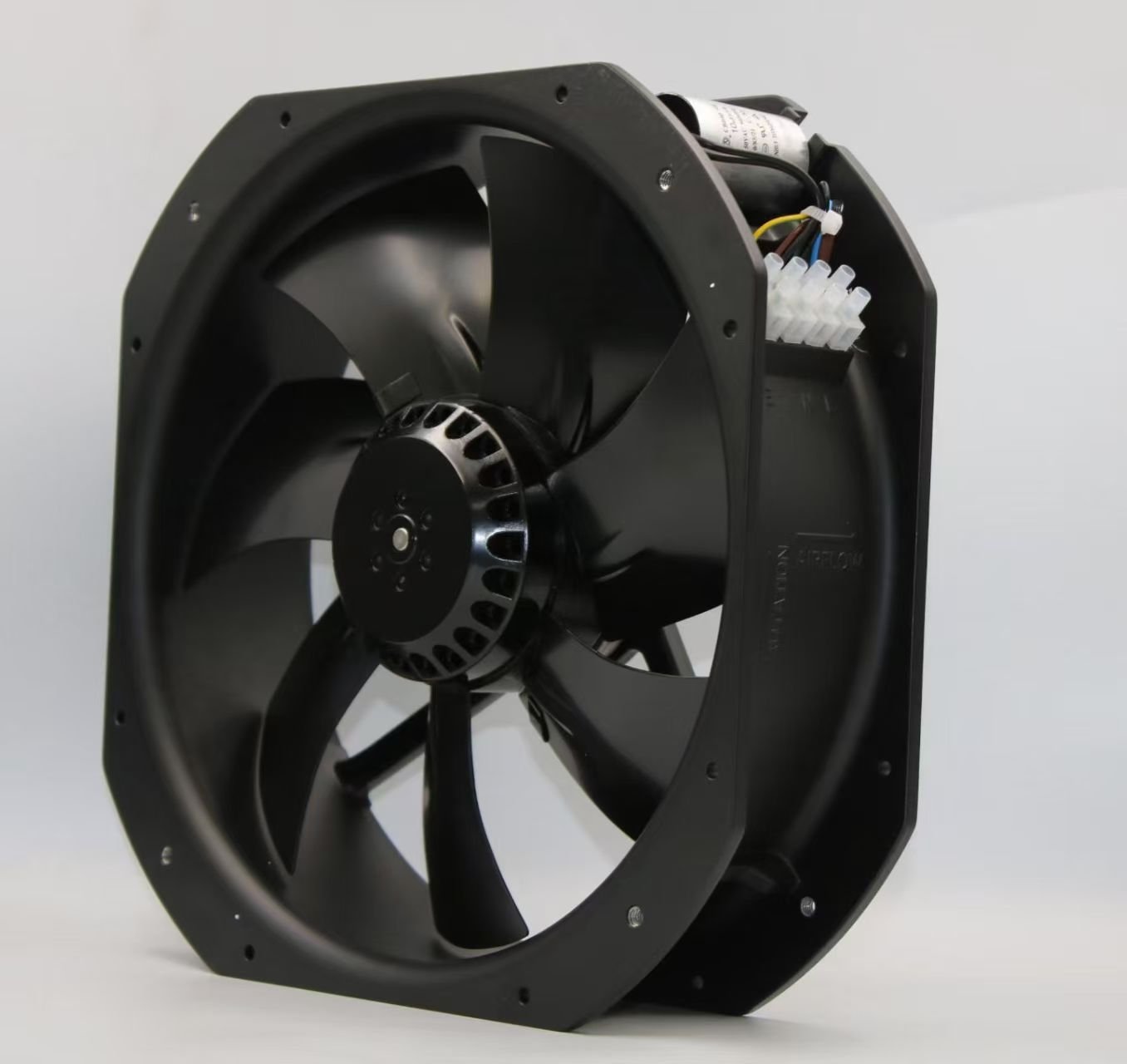
Axial fans move air mainly along the motor axis and are often suitable for direct ventilation through cabinets or equipment panels. Restricted passages, dense heat exchangers and changes in airflow direction may call for a different design. Compare actual curves rather than assuming one fan type always performs better.

If the airflow must turn through a compact duct, discuss DC blower options alongside axial alternatives. Provide a drawing of the installed air path so the supplier can review the available space and resistance.
4. Ask for model-specific evidence
- Mechanical: Dimensioned drawing, hole spacing, screw engagement, cable exit and installation clearances.
- Electrical: Rated and operating voltage, current, connector pinout, polarity and control-interface limits.
- Performance: Airflow and pressure curve, speed, power and acoustic data with measurement conditions.
- Environment: Operating temperature, bearing selection, installation orientation and documented protection level where required.
- Documentation: Exact part number and revision, material information and applicable model-level compliance documents.
A company quality-system certificate and a product approval answer different questions. Request documents for the exact model and intended market. Likewise, a service-life statement is only useful with its bearing type, temperature, duty and assessment conditions.
5. Evaluate engineering and production support
JyFan is the cooling-fan brand of Shenzhen Jinliya Technology Co., Ltd., established in 2012. Its stated facility includes six semi-automatic production lines and in-house testing capabilities. Review About JyFan and Manufacturing & Testing when preparing a supplier assessment.
Ask how the approved sample configuration is identified, how production checks are recorded and how material or component changes are communicated. For OEM / ODM requirements, agree on drawings, wiring, connectors, control functions and acceptance criteria before placing a production order.
6. Validate samples in the finished equipment
Test the candidate fan with the intended enclosure, vents, filters and power supply. Record ambient and critical component temperatures, fan speed and acoustic behavior under representative loads. Include the operating conditions that matter to your application, such as higher ambient temperature or filter loading.
Define pass/fail criteria before testing. Keep the sample part number, configuration and test setup with the results so production approval is traceable. A successful single-sample test supports that evaluated configuration; it does not establish performance for every model in a family.
7. Make the quotation comparable
Send each supplier the same specification and quantity assumptions. Request unit price, sample availability, production lead time, minimum order quantity, packaging, delivery terms and the documents supplied with the order. Confirm the quoted configuration explicitly, including any connector or control options.
JyFan can review standard models and application-specific options. Availability, MOQ and schedule are confirmed for the selected configuration and order; use a written quotation as the purchasing reference.
Your supplier inquiry checklist
- Equipment application, drawing and available fan dimensions.
- Supply voltage and frequency, where applicable.
- Required airflow at the intended pressure, plus noise limits.
- Ambient conditions, duty cycle and expected service requirements.
- Connector, cable length, speed control and monitoring signals.
- Sample quantity, forecast production quantity and target schedule.
Find a Fan for Your Application
Share your drawing and operating requirements. JyFan can review suitable models and the documentation needed for evaluation.
Explore Cooling Applications · Browse Product Families · Fan Guards & Filters